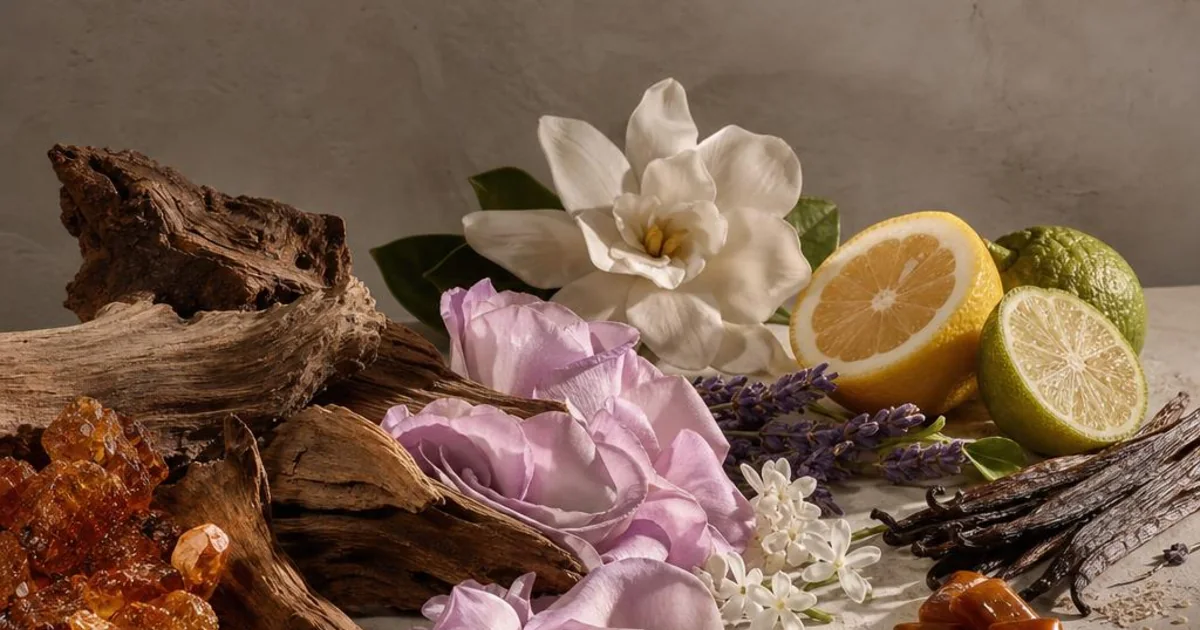
What is a fragrance family?
A fragrance family is a classification that groups fragrances sharing a dominant aromatic character. No single system is universally agreed upon — different houses and critics use different categories — but the major families are consistent enough to be genuinely useful when choosing and layering fragrances.
Floral
The largest fragrance family. Floral fragrances are built around flower extracts and synthetics — rose, jasmine, tuberose, peony, and many others. They range from soft and sheer (a light rose) to rich and opulent (a full tuberose soliflore). Florals layer well with musks (which extend them), woody bases (which give them structure), and light citrus (which brightens them).
Woody
Built on woods — sandalwood, cedarwood, oud, vetiver, patchouli, and similar materials. Woody fragrances can be dry and clean or rich and resinous. They're excellent layering anchors and pair naturally with almost any other family, particularly orientals, florals, and leather accords.
Oriental / Amber
Warm, rich, and typically long-lasting. Oriental fragrances are built on vanilla, amber, musks, resins, and spices. They tend to be the most tenacious family on skin. They layer beautifully with woods (deepening the warmth) and can contrast effectively with citrus or fresh fragrances to create a warm-opening combination.
Fresh / Citrus
Clean, bright, and typically the most volatile family. Citrus fragrances built on bergamot, lemon, grapefruit, and mandarin are excellent openers in a layered combination but often don't last long on skin without a heavier base to anchor them. Fresh aquatic fragrances fall into a related category — clean, ozonic, occasionally marine.
Gourmand
Edible, dessert-like fragrances built on vanilla, caramel, chocolate, praline, coffee, and similar accords. Gourmands layer well with woods (which give them some dryness and contrast) and less well with green or earthy fragrances, which tend to clash with their sweetness.
Fougère
A classic structure built around lavender, oak moss (or its synthetic equivalent), and coumarin (a warm, hay-like material). Fougères form the backbone of many traditional masculine fragrances. They layer well with woods and orientals but can overwhelm lighter floral or citrus profiles.
Chypre
One of the oldest and most complex fragrance structures: bergamot top, floral heart, and mossy/woody base with labdanum. Chypres tend to be sophisticated, long-lasting, and very well-suited to layering with leather accords and woody fragrances.
See how different families interact in the MixMode, or read about the fragrance wheel to understand how neighboring and contrasting families relate to each other.