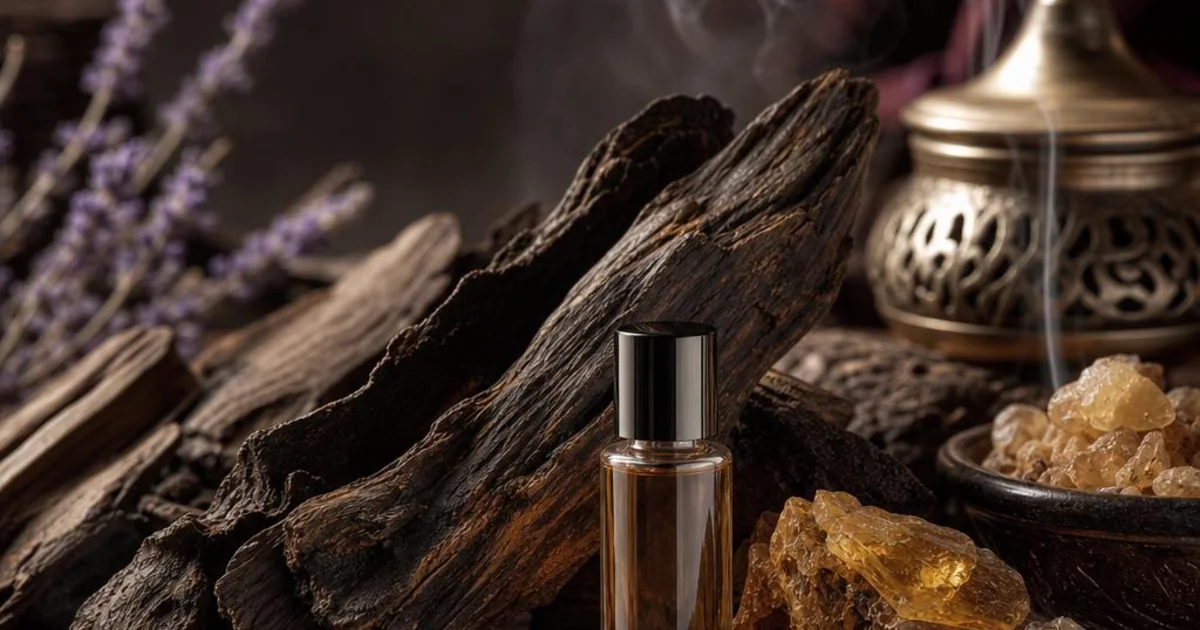
What oud is
Oud — also called agarwood, oudh, or aloeswood — is a dense, resinous heartwood that forms in Aquilaria trees when they are infected by a specific mould (Phialophora parasitica). The infected wood produces an aromatic resin as a defence mechanism; this resin-saturated wood is oud. Not all Aquilaria trees produce oud, and the quality varies significantly by region, tree age, and how the oud is extracted.
How it smells
High-quality natural oud is extraordinarily complex — simultaneously woody, animalic, smoky, sweet, and resinous. It smells ancient. The character varies significantly by origin: Indian oud tends to be darker and more barnyard-animalic; Cambodian oud is cleaner and sweeter; Hindi (from older Indian trees) is often the most intense and animalistic.
Most fragrances labelled "oud" use synthetic oud molecules or blends — materials that approximate the character of natural oud at a fraction of the cost. Synthetic ouds tend to be cleaner, less animalic, and more predictable than natural oud oil.
Why oud is expensive
Only a small percentage of Aquilaria trees produce the infection that creates oud. Wild agarwood trees have been overharvested to the point of endangerment in many regions. Sustainably farmed agarwood is increasingly available but takes many years to produce usable material. The most prized natural oud oils command extraordinary prices.
Oud in layering
Natural oud is so complex and dominant that it functions as a complete fragrance on its own in Middle Eastern traditions — applied directly to skin, clothing, or hair. In Western layering contexts, synthetic ouds are more practical. They serve as powerful base layers that anchor lighter fragrances, adding depth and longevity. Even small amounts (a single spray of an oud-heavy fragrance as a base) can significantly change the character and longevity of a lighter fragrance applied over it.
Find oud-forward fragrances in the SCNTMIX catalog and see how they layer with other fragrance families in the MixMode.